Value Expressions for GRAPH_TABLE
Purpose
Value expressions in WHERE and COLUMNS clauses inside GRAPH_TABLE inherit all the functionality supported in value expressions outside of GRAPH_TABLE. Additionally, inside GRAPH_TABLE, the following value expressions are available:
Property Reference
Purpose
Property references allow for accessing property values of vertices and edges.
Syntax
property_reference::=

property_name::=

Semantics
Syntactically, a property access is an element variable followed by a dot (.) and the name of the property. A property name is an identifier and may thus be either double quoted or unquoted.
The label expression specified for an element pattern determines which properties can be referenced:
-
If no label expression is specified, then depending on the type of element variable, either all vertex properties or all edge properties in the graph can be referenced.
-
Otherwise, if a label expression is specified, then the set of properties that can be referenced is the union of the properties of labels belonging to vertex (or edge) tables that have at least one label that satisfies the label expression.
If multiple labels satisfy the label expression but they define the same property but of a different data type, then such properties may only be referenced if the data types are union compatible. The resulting value will then have the union compatible data type.
If multiple labels satisfy the label expression while some labels have a particular property that other labels do not, then such properties can still be referenced. The property reference will result in null values for any vertex or edge that does not have the property.
Examples
Example 1
The following query lists the date of birth of all persons and universities in the graph:
SELECT GT.name, GT.birthday
FROM GRAPH_TABLE ( students_graph
  MATCH (p IS person|university)
  COLUMNS (p.name, p.dob AS birthday)
) GT
ORDER BY GT.birthday, GT.name;
Note that since only persons John, Bob, Mary, Alice have dates of birth while universities (ABC and XYZ) do not, null values are returned for universities. These appear as empty strings in the output:
NAME       BIRTHDAY
---------- ---------
John       13-JUN-63
Bob        11-MAR-66
Mary       25-SEP-82
Alice      01-FEB-87
ABC
XYZ
Example 2
The following query matches all PERSON vertices and returns their NAME and HEIGHT:
SELECT *
FROM GRAPH_TABLE ( students_graph
  MATCH (n IS person)
  COLUMNS ( n.name, n.height )
)
ORDER BY height;
The result is:
NAME           HEIGHT
---------- ----------
Mary             1.65
Alice	            1.7
Bob              1.75
John              1.8
Here, even though label PERSON does not have property HEIGHT, the property can still be referenced because vertex table PERSONS has labels PERSON and PERSON_HT and since label PERSON matches the label expression, the set of properties that can be referenced is the union of the properties of labels PERSON and PERSON_HT, which includes the property HEIGHT of label PERSON_HT.
Vertex and Edge ID Functions
Purpose
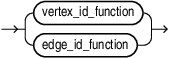
Vertex and edge ID functions allow for obtaining unique identifiers for graph elements.
Syntax
element_id_function::=
vertex_id_function::=

edge_id_function::=

element_reference::=
Semantics
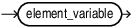
Syntactically, the VERTEX_ID and EDGE_ID functions take an element reference, which should be a vertex reference in case of VERTEX_ID and an edge reference in case of EDGE_ID. The two functions generate identifiers for graph elements that are globally unique within a database.
Content-wise, vertex and edge identifiers are JSON object that contains the following information:
-
Owner of the graph that the vertex or edge is part of.
-
Name of the graph that the vertex or edge is part of.
-
Element table that the vertex or edge is defined in.
-
Key value of the vertex or edge.
Examples
Example 1
The following query lists the vertex identifiers of friends of Mary:
SELECT CAST(p2_id AS VARCHAR2(200)) AS p2_id
FROM GRAPH_TABLE ( students_graph
  MATCH (p1 IS person) -[e1 IS friends]- (p2 IS person)
  WHERE p1.name = 'Mary'
  COLUMNS (vertex_id(p2) AS p2_id)
)
ORDER BY p2_id;
The result is:
P2_ID
--------------------------------------------------------------------------------------------------------
{"GRAPH_OWNER":"SCOTT","GRAPH_NAME":"STUDENTS_GRAPH","ELEM_TABLE":"PERSONS","KEY_VALUE":{"PERSON_ID":1}}
{"GRAPH_OWNER":"SCOTT","GRAPH_NAME":"STUDENTS_GRAPH","ELEM_TABLE":"PERSONS","KEY_VALUE":{"PERSON_ID":3}}
{"GRAPH_OWNER":"SCOTT","GRAPH_NAME":"STUDENTS_GRAPH","ELEM_TABLE":"PERSONS","KEY_VALUE":{"PERSON_ID":4}}
Example 2
The following query uses JSON dot-notation syntax to obtain a set of JSON objects representing the vertex keys of vertices corresponding to friends of Mary:
SELECT GT.p2_id.KEY_VALUE
FROM GRAPH_TABLE ( students_graph
  MATCH (p1 IS person) -[e1 IS friends]- (p2 IS person)
  WHERE p1.name = 'Mary'
  COLUMNS (vertex_id(p2) AS p2_id)
) GT
ORDER BY key_value;
The result is:
KEY_VALUE
----------------------------------------
{"PERSON_ID":1}
{"PERSON_ID":3}
{"PERSON_ID":4}
Example 3
The following query uses the JSON_VALUE function to obtain all the element table names of edges in the graph:
SELECT DISTINCT json_value(e_id, '$.ELEM_TABLE') AS elem_table
FROM GRAPH_TABLE ( students_graph
  MATCH -[e]-
  COLUMNS (edge_id(e) AS e_id)
)
ORDER BY elem_table;
The result is:
ELEM_TABLE
----------------------------------------
FRIENDS
STUDENT_OF
Vertex and Edge Equal Predicates
Purpose
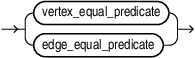
The vertex and edge equal predicates allow for specifying that two vertex variables (or two edge variables) should or should not bind to the same vertex (or edge).
Syntax
element_equal_predicate::=
vertex_equal_predicate::=

edge_equal_predicate::=

Examples
Example 1
The following query finds friends of friends of Mary. Here, the vertex_equal predicate is used to make sure Mary herself is not included in the result.
SELECT name
FROM GRAPH_TABLE ( students_graph
  MATCH (p IS person)
          -[IS friends]- (friend IS person)
            -[IS friends]- (friend_of_friend IS person)
  WHERE p.name = 'Mary' AND NOT vertex_equal(p, friend_of_friend)
  COLUMNS (friend_of_friend.name)
)
ORDER BY name;
The result is:
NAME
----------
Bob
John
SOURCE and Destination Predicates
Purpose
The SOURCE and DESTINATION predicates allow for testing if a vertex is the source or the destination of an edge. They are useful, for example, for determining the direction of edges that are matched via any-directed edge patterns.
Syntax
source_predicate::=

destination_predicate::=

Semantics
The SOURCE predicate takes a vertex and an edge as input and returns TRUE or FALSE depending on whether the vertex is (not) the source of the edge.
The DESTINATION predicate also takes a vertex and an edge as input and returns TRUE or FALSE depending on whether the vertex is (not) the destination of the edge.
Examples
Example 1
The following query matches FRIENDS edges that are either incoming or outgoing from Mary. For each edge, it return the NAME property for the source of the edge as well as the NAME property of the destination of the edge.
SELECT *
FROM GRAPH_TABLE ( students_graph
       MATCH (p1 IS person) -[e IS friends]- (p2 IS person)
       WHERE p1.name = 'Mary'
       COLUMNS (e.friendship_id,
                e.meeting_date,
                CASE WHEN p1 IS SOURCE OF e THEN p1.name ELSE p2.name END AS from_person,
                CASE WHEN p1 IS DESTINATION OF e THEN p1.name ELSE p2.name END AS to_person))
ORDER BY friendship_id;

FRIENDSHIP_ID MEETING_DATE FROM_PERSON TO_PERSON
------------- ------------ ----------- ---------
            2 19-SEP-00    Mary        Alice
            3 19-SEP-00    Mary        John
            4 10-JUL-01    Bob         Mary
Example 2
The following query find friends of friends of John such that the two FRIENDS edges are either both incoming or outgoing.
SELECT *
FROM GRAPH_TABLE ( students_graph
       MATCH (p1 IS person) -[e1 IS friends]- (p2 IS person)
               -[e2 IS friends]- (p3 IS person)
       WHERE p1.name = 'John'
         AND ((p1 IS SOURCE OF e1 AND p2 IS SOURCE OF e2) OR
             (p1 IS DESTINATION OF e1 AND p2 IS DESTINATION OF e2))
       COLUMNS (p1.name AS person_1,
                CASE WHEN p1 IS SOURCE OF e1
                  THEN 'Outgoing' ELSE 'Incoming'
                  END AS e1_direction,
                p2.name AS person_2,
                CASE WHEN p2 IS SOURCE OF e2
                  THEN 'Outgoing' ELSE 'Incoming'
                  END AS e2_direction,
                p3.name AS person_3))
ORDER BY 1, 2, 3;

PERSON_1   E1_DIRECTION PERSON_2   E2_DIRECTION PERSON_3
---------- ------------ ---------- ------------ ----------
John       Incoming     Mary       Incoming     Bob
John       Outgoing     Bob        Outgoing     Mary
Notice how the path from John via Mary to Alice is not part of the result since it has an incoming edge followed by an outgoing edge and thus not two edges in the same direction.
Aggregation in GRAPH_TABLE
Purpose
Aggregations in GRAPH_TABLE are used to compute one or more values for a set of vertices or edges in a variable-length path. This is done using the same Aggregate Functions that are also available for non-graph queries.
Syntax
All the aggregate functions that are available for non-graph queries are also available for graph queries. See Aggregate Functions for the syntax of these functions.
Aggregate functions can be used in WHERE and COLUMNS clauses in GRAPH_TABLE, with the restriction that WHERE clauses within quantified patterns may not contain aggregate functions.
Syntactically, the value expressions in the aggregations must contain references to vertices and edges in the graph pattern, rather than to columns of tables like in case of regular (non-graph) SQL queries.
Semantics
See Aggregate Functions for the semantics of aggregate functions.
The arguments of the aggregate function must reference exactly one vertex or edge variable via property references and/or vertex and edge ID functions. Furthermore, the degree of reference must be group, meaning that the vertex or edge that is referenced must be in a quantified path pattern and the aggregation must be specified outside of a quantified path pattern. Also see Element Variable for more details on the contextual interpretation of graph element references.
The order in which values are aggregated in case of LISTAGG, JSON_ARRAYAGG and XMLAGG is non-deterministic unless an ORDER BY clause is specified. For example: LISTAGG(edge1.property1 ORDER BY edge1.property1)). There is currently no way to explicitly order by path order in such a way that elements are ordered in the same order as the vertices or edges in the path. However, when omitting the ORDER BY clause, the current implementation nevertheless implicitly orders by path order, but it should not be relied upon as this behavior may change over time.
Restrictions
-
Only
WHEREclauses that are not within a quantified pattern may contain aggregations. For example, the graph patternWHEREclause as well as non-quantified element patternWHEREclauses may contain aggregations, while parenthesized path patternWHEREclauses may not contain aggregations since parenthesized path patterns currently have a restriction that they must always be quantified. -
The arguments of an aggregate function in
GRAPH_TABLEmust reference exactly one vertex or edge variable. They may reference that variable multiple times. -
References to the vertex or edge variable must be placed in a property reference or a vertex or edge ID function. For example,
COUNT(edge1)is not allowed butCOUNT(edge_id(edge1))andCOUNT(edge1.some_property))are. -
The referenced vertex or edge must have group degree of reference. For example,
MATCH -[e1]-> WHERE SUM(e1.prop) > 10is not allowed since variable e1 has singleton degree of reference within theSUMaggregate, whileMATCH -[e2]->{1,10} WHERE SUM(e2.prop) > 10 and MATCH -[e3]->{1,1} WHERE SUM(e3.prop) > 10are allowed since variablese2ande3have group degree of reference within theSUMaggregates. -
The arguments of an aggregate function in
GRAPH_TABLEcannot reference anything other than a vertex or edge declared within the graph pattern of theGRAPH_TABLE. For example, it is not possible to reference a column that is passed from an outer query. -
In case of
LISTAGG,JSON_ARRAYAGGandXMLAGGthere is no way to specify that the order of elements in the result should be in the order of the vertices or edges in the path, although the current implement nevertheless implicitly orders by path order.
Examples
Example 1
The following query finds all paths that have a length between 2 and 5 edges ({2,5}), starting from a person named Alice and following both incoming and outgoing edges labeled friends. Edges along paths should not be traversed twice (COUNT(edge_id(e) = COUNT(DISTINCT edge_id(e))). The query returns all friendship IDs along paths as well as the length of each path.
SELECT *
FROM GRAPH_TABLE ( students_graph
       MATCH (p IS person) -[e IS friends]-{2,5} (friend IS person)
       WHERE p.name = 'Alice' AND
             COUNT(edge_id(e)) = COUNT(DISTINCT edge_id(e))
       COLUMNS (LISTAGG(e.friendship_id, ', ') AS friendship_ids,
                COUNT(edge_id(e)) AS path_length))
ORDER BY path_length, friendship_ids;
Note that in the element pattern WHERE clause of the query above, p.name references a property of a single edge, while edge_id(e) within the COUNT aggregates accesses a list of element IDs since the edge variable e is enclosed by the quantifier {2,5}. Similarly, the two property references in the COLUMNS clause access a list of property values and edge ID values.
The result is:
FRIENDSHIP_IDS    PATH_LENGTH
----------------- -----------
2, 3              2
2, 4              2
2, 3, 1           3
2, 4, 1           3
2, 3, 1, 4        4
2, 4, 1, 3        4
Example 2
The following query finds all paths between university ABC and university XYZ such that paths have a length of up to 3 edges ({,3}). For each path, a JSON array is returned such that the array contains the friendship_id value for edges labeled friends, and the subject value for edges labeled student_of. Note that the friendship_id property is cast to VARCHAR(100) to make it type-compatible with the subject property.
SELECT *
FROM GRAPH_TABLE ( students_graph
       MATCH (u1 IS university) -[e]-{,3} (u2 IS university)
       WHERE u1.name = 'ABC' AND u2.name = 'XYZ'
       COLUMNS (JSON_ARRAYAGG(CASE WHEN e.subject IS NOT NULL THEN e.subject
                              ELSE CAST(e.friendship_id AS VARCHAR(100)) END) AS path))
ORDER BY path;
The result is:
PATH
-----------------------
["Arts","3","Math"]
["Music","4","Math"]
Example 3
Example 3 The following query finds all paths that have a length between 2 and 3 edges ({2,3}), starting from a person named John and following only outgoing edges labeled friends and vertices labeled person. Vertices along paths should not have the same person_id as John (WHERE p.person_id <> friend.person_id).
SELECT *
FROM GRAPH_TABLE ( students_graph
       MATCH (p IS person) ( -[e IS friends]-> (friend IS person)
                             WHERE p.person_id <> friend.person_id){2,3}
       WHERE p.name = 'John'
       COLUMNS (COUNT(edge_id(e)) AS path_length,
                LISTAGG(friend.name, ', ') AS names,
                LISTAGG(e.meeting_date, ', ') AS meeting_dates ))
ORDER BY path_length;
Above, the COLUMNS clause contains three aggregates, the first to compute the length of each path, the second to create a comma-separated list of person names along paths, and the third to create a comma-separate list of meeting dates along paths.
The result of the query is:
PATH_LENGTH NAMES               MEETING_DATES
----------- ------------------- -----------------------------------
          2 Bob, Mary           01-SEP-00, 10-JUL-01
          3 Bob, Mary, Alice    01-SEP-00, 10-JUL-01, 19-SEP-00